
What is a variable frequency drive?
Understanding Variable Frequency Drive (VFD) in Industrial Automation System
What is the Benefit of using Variable Frequency Drive (VFD)?
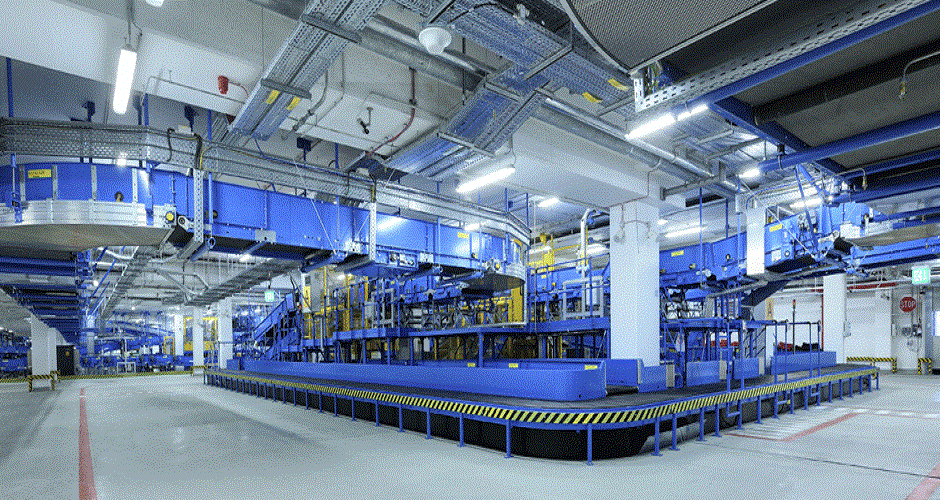
What Is a Variable Frequency Drive? A Complete Guide for Industrial Automation
In modern industrial facilities, electric motors power everything—from pumps and compressors to conveyors and fans. Traditionally, many of these motors ran at a constant speed regardless of process requirements. That approach works, but it often wastes energy and limits control over production systems.
This is where a Variable Frequency Drive (VFD) becomes essential. A VFD allows operators to precisely control the speed and torque of an electric motor by adjusting the frequency and voltage of the electrical power supplied to it.
By matching motor speed to the actual demands of the process, VFDs improve efficiency, reduce mechanical wear, and give engineers greater control over industrial equipment.
Today, variable frequency drives are widely used across industries such as manufacturing, oil and gas, water treatment, HVAC, and renewable energy systems. In many facilities, they are one of the most important components of modern industrial automation.
Understanding Variable Frequency Drives
A Variable Frequency Drive (VFD)—sometimes called an AC drive, adjustable speed drive, or inverter drive—is an electronic device used to control the speed and torque of an AC motor. It accomplishes this by varying the frequency and voltage of the electrical power supplied to the motor.
Electric motors normally operate at a fixed speed determined by the frequency of the power grid. For example, in many regions the standard electrical frequency is 50 Hz or 60 Hz. This fixed frequency means a motor connected directly to the power supply runs at a constant speed.
However, many industrial processes require motors to operate at different speeds depending on demand. Instead of using mechanical speed controls such as gearboxes or dampers, a VFD electronically adjusts the motor speed by changing the power frequency.
This capability gives engineers precise control over industrial equipment while significantly reducing energy consumption.
Why Motor Speed Control Matters
Electric motors account for a significant portion of industrial electricity consumption. Many industrial processes—especially pumps and fans—do not need to operate at full speed all the time.
Without a VFD, operators often rely on mechanical methods to regulate flow or pressure, such as:
Throttling valves
Dampers
Gear systems
Mechanical speed reducers
These solutions work, but they waste energy because the motor still runs at full speed.
By controlling the motor speed electronically, a VFD ensures the motor only operates at the level required for the process. This dramatically improves efficiency and operational control.
How a Variable Frequency Drive Works
A VFD works by converting the fixed-frequency AC power from the electrical supply into a variable-frequency output that controls motor speed.
Most variable frequency drives operate through three main stages.
Rectifier (AC to DC Conversion)
The first stage of a VFD is the rectifier.
Incoming AC power from the electrical supply is converted into direct current (DC). This conversion is typically performed using electronic components such as diodes or silicon-controlled rectifiers.
The rectifier essentially transforms the alternating current waveform into a direct current signal that can be processed further inside the drive.
DC Bus (Energy Storage and Filtering)
Once the AC power is converted into DC, it enters the DC bus, which acts as an energy storage stage.
The DC bus uses capacitors and inductors to smooth out voltage fluctuations and stabilize the electrical supply. This stage ensures that the power delivered to the next stage of the drive is stable and consistent.
The DC bus also temporarily stores electrical energy, allowing the system to maintain reliable operation during rapid load changes.
Inverter (DC to Variable AC Conversion)
The final stage of a VFD is the inverter.
The inverter converts the DC power back into AC power—but this time with a variable frequency and voltage. It does this using high-speed electronic switching devices such as insulated-gate bipolar transistors (IGBTs).
By adjusting the frequency of the output signal, the VFD controls the speed of the connected motor.
Higher frequency results in higher motor speed, while lower frequency reduces the motor speed.
Control System and Motor Feedback
Modern VFDs also include sophisticated control systems that regulate motor performance.
These control systems allow operators to set parameters such as:
Desired motor speed
acceleration and deceleration rates
torque limits
safety conditions
Some drives also integrate feedback from sensors or automation systems, allowing them to automatically adjust motor operation based on real-time conditions.
Key Components of a Variable Frequency Drive
Although designs vary across manufacturers, most VFDs include several essential components.
Input Rectifier
The rectifier converts incoming AC power into DC power. It forms the first stage of the drive’s power conversion process.
DC Link or DC Bus
The DC bus stabilizes and filters the DC power before it reaches the inverter. It often includes capacitors, inductors, and other components that regulate voltage levels.
Inverter Module
The inverter is responsible for generating the variable frequency AC output that drives the motor.
Using pulse-width modulation (PWM) technology, the inverter produces electrical waveforms that control motor speed and torque.
Control Electronics
The control electronics act as the “brain” of the VFD.
This system processes operator inputs, monitors electrical parameters, and ensures the drive operates within safe limits.
Modern drives may also support communication protocols that allow them to integrate with industrial automation systems.
Benefits of Using Variable Frequency Drives
Variable frequency drives offer several advantages that make them indispensable in modern industrial operations.
Energy Efficiency
One of the biggest benefits of VFDs is energy savings.
When motor speed is reduced even slightly, the power consumption of certain equipment—such as pumps and fans—drops dramatically. This occurs because power demand is proportional to the cube of the motor speed in many centrifugal systems.
As a result, VFDs can significantly reduce electricity costs in industrial facilities.
Improved Process Control
VFDs allow precise control of motor speed, which improves the accuracy of industrial processes.
Operators can easily adjust production rates, maintain consistent flow levels, and fine-tune equipment performance.
Soft Starting and Stopping
Another major advantage is the soft start capability.
Instead of starting instantly at full power, a VFD gradually increases motor speed. This reduces mechanical stress on motors, belts, and gear systems.
Soft starting also helps prevent electrical disturbances in the power supply.
Reduced Equipment Wear
Because VFDs control acceleration and deceleration smoothly, they reduce wear on mechanical components.
This leads to: longer equipment life, fewer maintenance issues, and reduced downtime.
Better Automation Integration
Modern variable frequency drives integrate easily with automation systems such as PLCs and SCADA platforms.
This allows engineers to control motor-driven equipment remotely and monitor system performance in real time.
Applications of Variable Frequency Drives
Variable frequency drives are used across many industries where precise motor control is required.
Pump Systems
Pumps are one of the most common applications for VFDs.
In water treatment plants, irrigation systems, and chemical processing facilities, VFDs regulate pump speed to maintain proper flow and pressure levels.
Fan and HVAC Systems
Heating, ventilation, and air-conditioning systems rely heavily on VFD technology.
Instead of operating fans at full speed, VFDs adjust airflow based on demand, significantly reducing energy consumption.
Conveyor Systems
Manufacturing facilities often use VFDs to control conveyor speed.
This allows operators to synchronize production lines and adjust product movement during different stages of manufacturing.
Compressors
Air compressors and refrigeration systems use VFDs to regulate pressure levels while improving energy efficiency.
Industrial Machinery
Variable frequency drives are also widely used in equipment such as: mixers, extruders, cranes, and machine tools.
These applications benefit from the precise speed control and improved reliability provided by VFD technology.
How to Choose the Right Variable Frequency Drive
Selecting the correct VFD requires careful consideration of several factors.
Motor Power Rating
The drive must be capable of handling the motor’s voltage and power requirements.
Application Type
Different applications—such as pumps, conveyors, or compressors—may require different control strategies.
Environmental Conditions
Industrial environments may expose equipment to heat, dust, moisture, or vibration.
Communication Requirements
Modern drives often need to integrate with automation networks such as Modbus, Ethernet/IP, or Profibus.
Proper drive selection ensures reliable operation and optimal system performance.
- Industrial Automation Fundamentals
- Industrial Communication Protocols
- Industrial Instrumentation Control
- Industrial Sensors & Measurement
- Motion and Process Control
- PLC Programming & Controllers
- SCADA and DCS Systems
- Servo Motors and Motor Drives
Frequently Asked Questions (FAQ)
What does VFD stand for?
VFD stands for Variable Frequency Drive. It is an electronic device used to control the speed and torque of AC motors by adjusting the frequency and voltage of the electrical supply.
How does a variable frequency drive control motor speed?
A VFD controls motor speed by converting AC power into DC power and then converting it back into AC power with a variable frequency. Changing the frequency of the electrical supply changes the motor speed.
Where are variable frequency drives used?
VFDs are commonly used in pumps, fans, conveyors, compressors, HVAC systems, and industrial manufacturing equipment.
What are the benefits of using a VFD?
Major benefits include:
energy savings
improved motor control
reduced mechanical stress
longer equipment life
better process efficiency
Can a VFD reduce energy consumption?
Yes. By matching motor speed to the actual process demand, VFDs significantly reduce energy consumption, especially in pump and fan applications.
Your One-Stop Source for Reliable Automation & Process Control Equipment
Access trusted process control equipment, expert support, and fast sourcing—all in one place.
-
AC Drives 18,165 Products
-
Butterfly Valve236 Products
-
Circuit Breakers2,226 Products
-
Contactors567 Products
-
Counters78 Products
-
Encoder117 Products
-
Fanuc Main Board1,376 Products
-
Flow Transmitter (Flow meter)552 Products
-
HMI/Touch Screen592 Products
-
Industrial Device Servers125 Products
-
Inverter911 Products
-
Network/Signal2 Products
-
Others4,502 Products
-
Power Supply218 Products
-
Pressure Transmitter146 Products
-
Programmable Logic Controller (PLC)6,290 Products
-
Relay927 Products
-
Sensor2,221 Products
-
Servo Motors & Motor Drives4,741 Products
-
Switch897 Products
-
Timer93 Products
-
Uncategorized1,141 Products
-
Valve Controller & Manifolds17 Products
-
Variable Frequency Drives (VFD)257 Products
-
Yokogawa Remote Indicators16 Products