What is Assembly Line Automation?
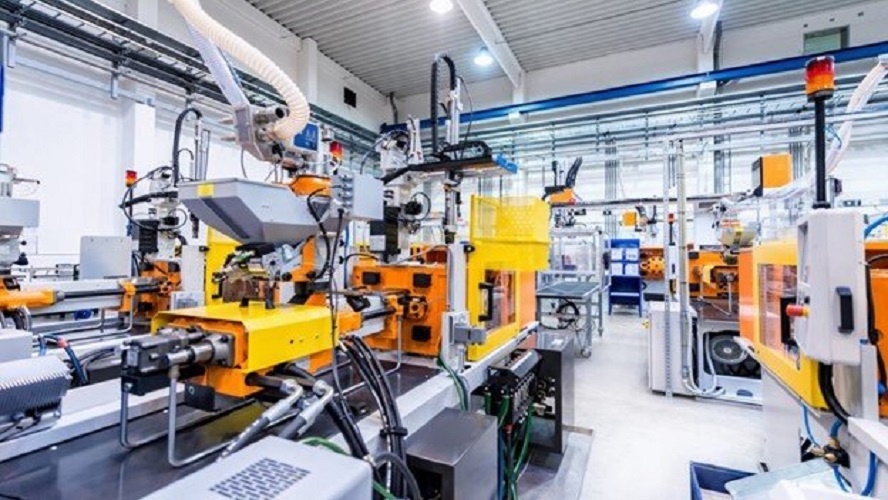
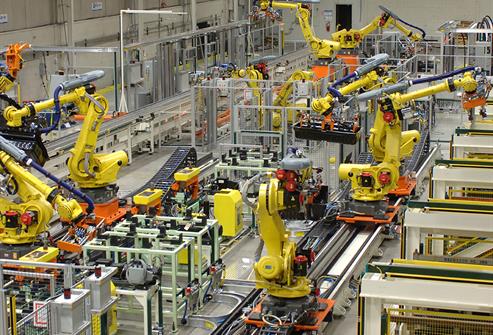
An automated assembly line involves using assembly and/or process stations that progressively produce manufacturers’ end products. These lines may deploy robotics, conveyance, vision, or other automated technology to complete production tasks in multiple stations, moving the part or product through each step in an automated production sequence. Automated assembly lines can take many forms, including lean automation, flexible automation, and fixed or hard automation.
Types of Assembly Line Automation
Automation solutions are not one-size-fits-all. The highest return on investment comes from integrating a system that is targeted to meet a specific need and solve a business problem in your production. There are many types of automation, including bench-top assembly stations, semi-automated lines, lean automation, continuous motion, fixed automation, and flexible automation. Continue reading to understand some of the differences between these types of assembly line automation.
Fully Automated vs. Semi-automated
A fully automated production line describes equipment and systems that complete all or part of the process with machines and virtually little to no human intervention. In a fully automated production environment, employee involvement is typically limited to loading product recipes into the machine interface before supervising and monitoring the system for issues, such as part replenishment that requires loading product components into the respective feed systems.
Semi-automated systems employ more human intervention to initiate machine commands following the manual loading of parts into fixtures or other such tooling. This type of system can involve humans working side by side with automation. For example, some tasks require more dexterity than a human may be able to reasonably handle, so collaborative robotics and other such automation assistance systems can be added. In another example, employees may be in charge of moving parts or products from one assembly station to another, while more automated systems at these stations complete repetitive tasks.
Lean Manufacturing Automation
Today, many manufacturers follow an overall lean manufacturing strategy, whereby automation is only added to steps in the assembly process where it will add value. In these systems, comprehensive studies are done to determine where automation adds value to the process and areas where it does not — these stations are stripped to basics relying on humans to carry out the tasks. Companies do not install technology such as robotics, vision, conveyance, or other systems in this type of automation unless they add value to the overall production line. Conversely, if automation adds value, then the manufacturers can choose to make the investment and adopt it. As an example, manufacturers who produce low volumes of select products would find that the capital investment required to add automation does not have a favorable return on investment (ROI), thereby making it more cost-effective for employees to move parts themselves or keep parts in one place instead of installing a high-speed robot to move them.
Continuous Motion within High-throughput Manufacturing Automation
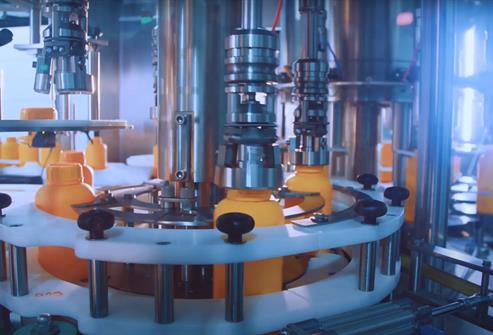
Continuous motion technology is a key component in high-throughput manufacturing automation. This assembly technology typically involves using mechanical or servo-based cams, tooling, and sometimes machine vision to optimize cycle time to attain high throughput speeds that could never be achieved through manual labor or semi-automatic automation. Benefits of continuous motion include higher system overall equipment effectiveness (OEE), reduced cycle time, and increased system throughput largely due to the optimized time for material transfers between subsequent assembly/process stations. Typically, manufacturers who make a consistent product, in which the assemblies are identical, benefit from integrating continuous-motion technology into their assembly lines. Advances in servo-based cam technology is expanding the possibilities of this technology into areas such as medical device assembly and filling applications requiring high-throughput — in these instances, continuous motion is growing.
Fixed vs. Flexible Automation
Fixed, or hard, automation involves applications that use hard-tooled automation platforms that are made specifically for the product and generally do not allow flexibility due to the tooling being dedicated to a specific product. Fixed or hard automation is starting to see use of robotics, vision, and other technology as their price point has come down to justify their use in certain portions of the system; however, as these products also offer flexibility that really does not get used in these applications, it only makes sense to use them when their cost is in the realm of a hard-tooled station. This is largely because in a hard or fixed automation application, the way the product is assembled is done the same way every time. Typical applications also include material handling and related conveyance systems. These applications usually are much faster and more repeatable than traditional manual methods. However, operators must retool and reprogram the technology for each new product.
Comparatively, programmable or soft automation applications are known as flexible automation because they can adapt operations to new parts or products with little or no downtime due to preprogrammed recipes that allow ease of product changeover. As a result, these applications typically do not have output as high volume as fixed automation.
Benefits of Automating Your Production Line
Advantages of automation in your production line include boosting capacity, increasing quality and lowering per-unit production costs, allowing companies to realize higher ROI. Companies that work through applying the right automation related to their product complexity, mix and such can achieve considerable savings in labor costs and repeatable quality. Traditional assembly and processing through only manual labor allows for higher chances of error and product waste; plus, manual labor is reliant on employee attendance to ensure the factory labor source, which is particularly challenging during unplanned situations such as the pandemic. Automation solutions run with limited personnel, reduce error and scrap, and increase productivity, lowering product unit cost and applying more money to the bottom line.
-
AC Drives 18,160 Products
-
Butterfly Valve236 Products
-
Circuit Breakers2,226 Products
-
Contactors567 Products
-
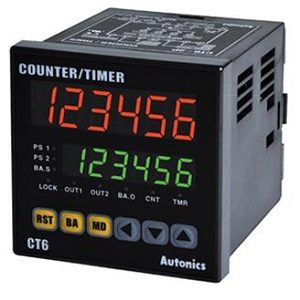
Counters78 Products
-
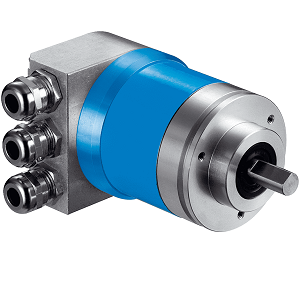
Encoder117 Products
-
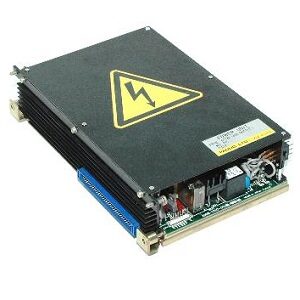
Fanuc Main Board1,376 Products
-
Flow Transmitter (Flow meter)80 Products
-
HMI/Touch Screen592 Products
-
Inverter911 Products
-
Network/Signal4 Products
-
Others4,668 Products
-
Power Supply218 Products
-
Pressure Transmitter143 Products
-
Programmable Logic Controller (PLC)6,288 Products
-
Relay927 Products
-
Sensor2,221 Products
-
Servo Motors & Motor Drives4,363 Products
-
Switch897 Products
-
Timer93 Products
-
Uncategorized1,148 Products
-
Valve Controller & Manifolds15 Products
-
Variable Frequency Drives (VFD)258 Products
-
Yokogawa Remote Indicators16 Products